ECOWORX RESILIENT PLANK AND TILE INSTALLATION
ECOWORX RESILIENT + TOTALWORX 4200 ADHESIVE
Product Overview
The Ecoworx Resilient platform is a non‑PVC based flooring solution engineered to deliver durability and long-term performance. Its construction differs from traditional resilient flooring systems to provide the necessary structural integrity required for demanding installation environments.
Totalworx 4200 Adhesive Technology
Totalworx 4200 is a hard‑set adhesive designed to be installed using a semi‑wet application method. The adhesive features advanced cross‑linking technology, which allows the bond to continue strengthening throughout the curing process. As curing occurs, the adhesive develops increased bond strength, holding power, and adhesive transfer, resulting in a secure and durable installation.
System Performance
When used together, the Ecoworx Resilient platform and Totalworx 4200 adhesive function as a fully engineered system. The bond between the product and the adhesive enhances overall performance, contributing to installation longevity, stability, and long-term reliability. This system-based approach helps ensure consistent results when installation guidelines are properly followed.
1 GENERAL INFORMATION
1.1 Site Conditions
-
It is recommended that floor covering installation shall not begin until all other trades are completed.
-
Material should always be visually inspected prior to installation. Any material installed with visual defects will not be considered a legitimate claim as it pertains to labor cost.
-
HVAC System: Must be operational, maintaining the following conditions 7 days prior to, during and after installation.
-
Temperature: The installation site must be between 65 o F and 85 o F.
-
Acclimation: 48-hour acclimation required for both flooring and adhesive.
-
Surface temperature should not exceed 100F (38C) from sunlight, bed bug treatment, steam mop, etc, and temperatures should not fall below 55F (13C). Exposing product to temperatures outside the recommended range could cause expansion of resilient flooring.
1.2 Substrate Testing
-
All substrates to receive moisture sensitive floor covering require proper moisture testing.
-
Moisture Testing per ASTM F-1869 CaCl: Results must not exceed 8 lbs.
-
Moisture Testing per ASTM F-2170: Results must not exceed 90%.
-
pH / Alkalinity per ASTM F-3441: Results must be between 7-10.
-
If the subfloor exceeds these values, moisture mitigation should be performed.
-
Perform Bond testing to determine compatibility of adhesive to the substrate.
1.3 gapping
The leading causes of objectionable gaps in LVT are improper adhesive selection, poor acclimation, and lack of a stable temperature before, during, and 72 hours after installation.
A stable temperature means keeping the product, subfloor, and ambient temperatures as close to each other as possible. Deviation between these temperatures can cause product growth or shrinkage.
Shaw recommended adhesives have been developed and tested to provide exceptional shear strength. After the adhesive cures, this high shear strength will minimize product gapping caused by temperature changes.
Shaw does not cover damage or gapping resulting from the use of pressure sensitive adhesives due to their typically low shear strength.
1.4 Storage And Handling
-
Store cartons of tile or plank products flat and squarely on top of one another. Preferably, locate material in the “center” of the installation area (i.e. away from vents, direct sunlight, etc.)
-
Flooring material and adhesive must be acclimated to the installation area for at least 48 hours before installation.
-
When palletizing on a jobsite vinyl plank or tiles need to be stacked 2 rows high side by side with no airspace between. Then quarter turned for 2 rows side by side, not to exceed 12 boxes high. A 5/8” or thicker plywood must also be placed on the pallet first.
-
Do not stack pallets 2 high unless utilizing plywood achieving a minimum of 1” thickness between pallets.
2 APPROVED SUBSTRATES
2.1 Concrete
NEW AND EXISTING CONCRETE SUBFLOORS SHOULD MEET THE GUIDELINES OF THE LATEST EDITION OF ACI 302 AND ASTM F 710, “STANDARD PRACTICE FOR PREPARING CONCRETE FLOORS TO RECEIVE RESILIENT FLOORING” AVAILABLE FROM THE AMERICAN SOCIETY FOR TESTING AND MATERIALS, 100 BARR HARBOR DRIVE, WEST CONSHOHOCKEN, PA 19428; 610‐832‐9585; HTTP://WWW.ASTM.ORG.
WARNING: DO NOT SAND, DRY SWEEP, DRY SCRAPE, DRILL, SAW, BEAD BLAST OR MECHANICALLY CHIP OR PULVERISE EXISTING RESILIENT FLOORING, BACKING, LINING FELT, ASPHALTIC “CUTBACK” ADHESIVES OR OTHER ADHESIVES.
These products may contain either asbestos fibers and/or crystalline silica. Avoid creating dust. Inhalation of such dust is a cancer and respiratory tract hazard. Smoking by individuals exposed to asbestos fibers greatly increases the risk of serious bodily harm. Unless positively certain that the product is a non‐ asbestos‐containing material, you must presume it contains asbestos. Regulations may require that the material be tested to determine asbestos content and may govern the removal and disposal of material. See current edition of the Resilient Floor Covering Institute (RFCI) publication Recommended Work Practices for Removal of Resilient Floor Coverings for detailed information and instructions on removing all resilient covering structures. For current information go to www.rfci.com.
2.2 Lightweight or gypsum based Concrete
-
Lightweight aggregate concrete having dry densities greater than 90 lbs. per cubic foot may be acceptable under flooring.
-
Concrete slabs with heavy static and/or dynamic loads should be designed with higher strengths and densities to support such loads.
-
Perform Bond testing to determine compatibility of adhesive to the substrate. Shaw 9050 primer can be utilized to promote adhesion.
2.3 Wood Subfloors
Wood subfloors must be structurally sound and conform to guidelines of ASTM F 1482 and in compliance with local building codes
-
Double‐Layered APA rated plywood subfloors should be a minimum 1" total thickness, with at least 18" well-ventilated air space beneath.
-
Insulate and protect crawl spaces with a vapor retarder covering the ground.
-
It is recommended your chosen APA underlayment grade panels be designed for installation under flooring and carry a written warranty covering replacing the entire flooring system.
-
Always follow the underlayment manufacturer’s installation instructions.
-
Particleboard, chipboard, flakeboard, OSB (Oriented Strand Board), hardboard or similar are not recommended sub floor materials and require an additional layer of an APA 1/4" underlayment grade panel.
-
DO NOT install over sleeper construction sub floors or wood sub floors applied directly over concrete.
-
Not recommended directly over fire‐retardant treated plywood or preservative treated plywood.
-
Crumb rubber underlayments are not an acceptable option for use with resilient floor coverings due to performance issues resulting from chemical incompatibilities.
2.4 Strip – Plank Wood Flooring
-
Due to expansion/contraction of individual boards during seasonal changes a 1/4" (6.3mm) or thicker APA rated underlayment panels must be installed over these types of subfloors.
-
Wood flooring installed directly over concrete is NOT an approved subfloor.
2.5 Existing Floor Coverings
2.5.1 Resilient Flooring
-
Must be single layered, non-cushion backed, fully adhered, and smooth.
-
Show no signs of moisture or alkaline.
-
Waxes, polishes, grease, and grime must be removed.
-
Cuts, cracks, gouges, dents, and other irregularities in the existing floor covering must be repaired or replaced.
NOTE: THE RESPONSIBILITY OF DETERMINING IF THE EXISTING FLOORING IS SUITABLE TO BE INSTALLED OVER TOP OF WITH RESILIENT, RESTS SOLELY WITH INSTALLER/FLOORING CONTRACTOR ON SITE. IF THERE IS ANY DOUBT AS TO SUITABILITY, THE EXISTING FLOORING SHOULD BE REMOVED, OR AN ACCEPTABLE UNDERLAYMENT INSTALLED OVER IT. INSTALLATIONS OVER EXISTING RESILIENT MAY BE MORE SUSCEPTIBLE TO INDENTATION.
2.5.2 Quarry Tile, Terrazzo, Ceramic Tile, Poured Floors (Epoxy, Polymeric, Seamless)
-
Must be totally cured and well bonded to the concrete and free of any residual solvents and petroleum derivatives.
-
Waxes, polishes, grease, grime, and oil must be removed.
-
Show no signs of moisture or alkalinity.
-
Cuts, cracks, gouges, dents, and other irregularities in the existing floor covering must be repaired or replaced.
-
Fill any low spots, holes, chips, and seams that may telegraph through the new flooring.
-
Grind any highly polished or irregular/smooth surfaces.
-
Quarry tile or Ceramic tile grout joints and textured surfaces must be filled with an embossing leveler or substrate manufacturer approved material.
2.5.3 Raised Access Panel Subfloors
-
Raised access panels must be stable, level, flat, free, and clean of existing adhesives.
-
24" x 24" panels are recommended.
-
Lippage (variation of height) between panels must not exceed 0.0295” (0.75 mm)
-
Gaps between panels must not exceed 0.039” (1mm)
-
There should be no deflection of the individual panels – Concave less than 0.0295” (0.75 mm)
-
Flatness 1/8” in 10’
-
Stagger the flooring tiles/planks to overlap the access panels.
-
Telegraphing of access panel seams may be visible and is not considered a product defect nor warranted by the flooring manufacturer.
If needed overlay the panels with a 1⁄4” (6 mm) plywood and properly fasten to the access panels prior to the installation of the floorcovering. Prior to underlayment installation, repair any loose or unstable panels. Use the appropriate installation methods for the product.
2.6 Radiant Heated Floors
The heating system's components must have a minimum of 1/2" separation from the flooring product. The system must be on and operational for at least 2 weeks prior to installation to reduce residual moisture. Three days prior to installation, lower the temperature to 65 degrees, after installation gradually increase the temperature in increments of 5° F to avoid overheating. The maximum operating temperature should never exceed 85°F. Use of an in-floor temperature sensor is recommended to avoid overheating. Contact the manufacturer of your radiant heating system for further recommendations.
2.6.1 Electric Radiant Floors
Consist of electric cables (or) mats of electrically conductive materials mounted on the subfloor below the floor covering. Mesh systems are typically embedded in thin sets. When embedding the system components, use cementitious patching and leveling compounds that meet or exceed Shaw’s maximum moisture level and pH requirements. Use of gypsum-based patching and/or leveling compounds which contain Portland or high alumina cement and meet or exceed the compressive strength of 3,000 psi are acceptable.
2.6.2 Hydronic Radiant Floors
Pump heated water from a boiler through tubing laid in a pattern under the flooring. Typically installed in channels under a wooden subfloor (or) imbedded in concrete slabs.
3 SUBSTRATE PREPARATION
-
All substrates must be structurally sound, clean, dry, and flat prior to installation. Surfaces must be free of contaminants including, but not limited to: dust, dirt, oil, grease, paint, curing compounds, concrete sealers, adhesive residues, loosely bonded toppings, and any other materials or conditions that may inhibit proper adhesion.
-
Substrate flatness must conform to the following tolerances:
-
Maximum deviation of 1/8 inch over 6 feet (3.2 mm over 1.8 m)
-
Maximum deviation of 3/16 inch over 10 feet (4.8 mm over 3.0 m)
-
Fill depressions or cracks with a cementitious patching / leveling compound that meet or exceed Shaw Industries maximum moisture level and pH requirements. Use of gypsum-based patching and/or leveling compounds which contain Portland or high alumina cement and meet or exceed the compressive strength of 3,000 psi (20684 kPa) are acceptable.
-
Dormant cracks wider than 1/32 inch (0.8 mm) may be repaired using Prepworx CJR400.
-
For cracks and saw cuts exceeding 1 inch (25.4 mm) in depth, the use of Prepworx MRS101 is recommended.
-
Moisture Mitigation: For new or existing concrete substrates exhibiting moisture levels that exceed the limits specified for products and/or adhesives, reference either of the two systems below for mitigation.
-
Totalworx Moisture Control Solution
-
Totalworx Vapor Barrier Solution
-
Trench Moisture Mitigation: For newly poured concrete trenches (e.g., plumbing), apply a two-part epoxy moisture barrier such as PrepWorx MCS310 to prevent moisture-related flooring failures. Ensure substrate preparation aligns with Shaw’s installation standards.
-
Use Prepworx CJR400 at the interface between new and existing concrete.
-
Extend Prepworx MCS310 coverage across the trench and a minimum of 8 inches (203 mm) onto the adjacent slab.
-
Concrete and terrazzo substrates need to be a minimum CSP 3 (maximum CSP 5) by use of shot/bead blasting.
-
Do not install flooring over substrates that have been chemically abated: Chemically treated surfaces may compromise adhesion and affect flooring performance.
-
Curing compounds: (DO NOT USE). If present, they can interfere with the bond of the adhesive to the concrete. Seek assistance from a substrate manufacturer if curing agents are detected.
-
Sweeping Compounds: Green sweeping compounds can be used but must be swept and removed immediately.
-
For dusting / powdering / porous concrete / lightweight concrete prime with a latex primer such as 9050.
4 ADHESIVES AND APPLICATION
NOTE: DO NOT use adhesive as a pressure sensitive adhesive. Installation of EcoWorx Resilient plank and tiles requires a semi-wet to wet installation. This will require determining the amount of adhesive spread and product installed to achieve adequate transfer and bond of adhesive to product and substrate. Refer to adhesive guidelines for additional information.
To receive an underbed warranty, the product being installed must be approved for underbed applications (see product specification) and must be installed with LokWorx+ Resilient 4200.
|
Adhesive
|
CaCl Limit
|
RH Limit
|
PH Limit
|
|
4200
|
12
|
99%
|
5-12
|
|
MS Resilient (Wet Areas)
|
N/A
|
N/A
|
N/A
|
|
Substrate Porosity*
|
Trowel Size
|
Coverage
|
|
Non-porous - 4200/MS Resilient
|
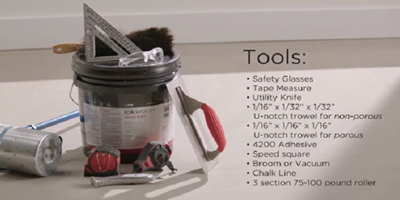
1/16” x 1/32” x 1/32” U-notch
|
175-225 ft2 / gallon
|
|
Porous - 4200
|
1/16” x 1/16” x 1/16” Sq-notch
|
140-170 ft2 / gallon
|
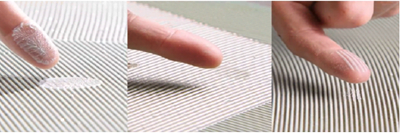
*Porosity as determined per ASTM F3191. If a drop of water is fully absorbed by the subfloor in 1 minute or less, the subfloor should be considered porous. Otherwise, it should be considered nonporous.
Working Time Examples
Wet Dry Ready
5 INSTALLATION
5.1 Layout
-
Install using conventional tile and plank installation techniques.
-
Carefully determine where to begin EcoWorx Resilient tile or plank installation.
-
It is customary to center rooms and hallways, so borders are not less than half a tile or plank.
-
Measure the installation in both directions.
-
Mark center line A for length of room, following with a center line of the width B.
-
Determine layout is square my using the 3,4,5 method (Pythagorean Theorem).
5.2 Applying Adhesive
-
NOTE: DO NOT use adhesive as a pressure sensitive adhesive. Installation of EcoWorx Resilient plank and tiles requires a semi-wet to wet installation.
-
Refer to Installation guidelines on bucket of adhesive for open and working times.
-
Spread adhesive using the trowel per installation guidelines. If the trowel notches show wear it is recommended to replace.
-
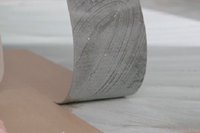
Ensure adequate transfer of adhesive to the back of the plank.
Lockworx + Resilient 4200
MS Resilient: 100% Transfer
5.3 Installing EcoWorx Resilient
-
Confirm back of product is clean of debris or dust prior to installation.
-
Flooring should have a minimum of 6 – 8" seam stagger for planks. 1/2 or 1/3 stagger for tiles.
-
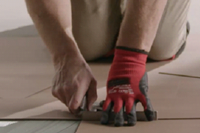
Once the adhesive open time is achieved, place the first plank or tile along the chalk line.
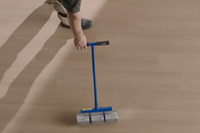
- Repeat the process of installing the first row planks. For tile installation a pyramid layout is recommended
-
Cut plank or tiles using a sharp utility knife and straight edge.
-
Make sure cut edges are always against the wall.
-
Roll the plank or tile with a 3 section 100 lb. roller. Re‐roll the entire glued flooring area with the 100 lb. roller within the working time of the adhesive. Continue to roll the floor throughout the working day to ensure a proper bond.
NOTE: Adhering tape to the surface of the flooring could damage the surface. DO NOT use tape to secure floor protection directly to the flooring surface during construction or renovation. Adhere tape to the protection material, such as Ramboard, and adhere the tape to base molding along the wall.
NOTE: Recommended to use floor protection after installation. DO NOT use a plastic adhesive-based protection system.